
Health Research, Innovation and Clinical Practice More Closely Interlinked
New Innovation Cluster Strengthens Rhine-Main Region
Leading stakeholders from medicine, academia and industry in Darmstadt are establishing a Health Care Innovation Cluster. The aim is to strengthen the Rhine-Main region as a hub for applied health research, AI-based medicine and clinical innovation. The cluster promotes networking, clinical trials and spin-offs, and creates new infrastructures for research, knowledge transfer and healthcare provision.
With the signing of a letter of intent, leading institutions from the fields of medicine, science and industry have launched the installation of the Health Care Innovation Cluster in Darmstadt. The partners include the Klinikum Darmstadt, Technical University of Darmstadt, the Fraunhofer Institute for Computer Graphics Research IGD, hessian.AI, HEAG Holding AG, and Merck, a leading science and technology company. The aim is to establish the Rhine-Main Region as a leading site for applied health research, medical innovations and artificial intelligence in healthcare.
“With this cluster, TU Darmstadt is adding the important future building block of healthcare to its innovation portfolio,” says Prof Dr Thomas Walther, Vice President for Innovation and International Affairs at TU Darmstadt, adding: “Via this cluster, our research and start-up community, with its clear focus on relevance, can open up new fields of activity, gain easier access to medical problems and turn developments into application more quickly. And thus, ultimately contribute to the benefit of all.”
“With the Health Care Innovation Cluster, we are creating a structure in which innovation does not arise alongside healthcare, but rather from healthcare itself,” explains Dr Jörg Noetzel, Chief Medical Officer of Klinikum Darmstadt. “The hospital aims to become an active development partner for science and industry – with the clear goal of bringing medical advances to patients more quickly and implementing innovative workflows for medical professionals.”
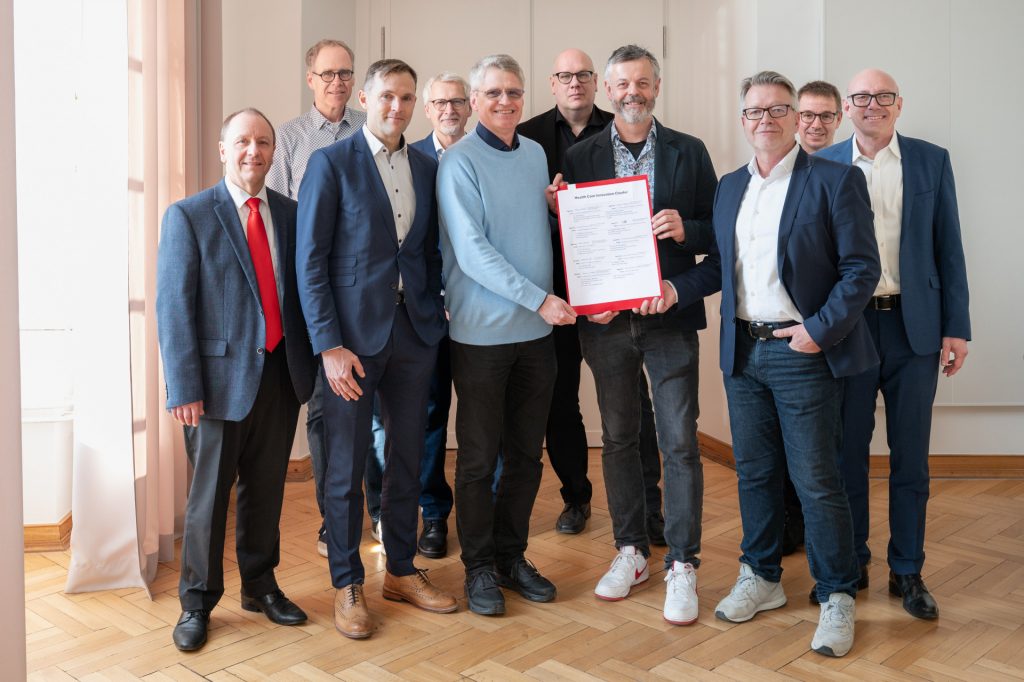
(v.l.n.r.) Prof. Dr. med. Michael Wild/ Klinikum Darmstadt, Dr.-Ing. Christoph Rensing/TUDa, Dr. Sebastian Hoff/Merck, Dr. Wolfgang Müller-Wittig/Fraunhofer IGD, Prof. Dr. Thomas Walther/TUDa, Dr. Wolfgang Heenes/hessian.AI, Prof. Dr. med. Rainer Kollmar/ Klinikum Darmstadt, Dr. med. Jörg Noetzel/ Klinikum Darmstadt, Daniel Pfeffer/HEAG, Prof. Dr. Klaus-Michael Ahrend/HEAG
“Hospital of the future”
Innovative medical products, digital health solutions and AI-based procedures will be developed in direct collaboration with the hospital, scientifically evaluated and tested in everyday care. “The Innovation Cluster is creating a real-world clinical laboratory in Darmstadt for the “hospital of the future” – often described as Hospital 4.0 or 5.0 – in which digitalisation, automation, data-driven medicine and patient-centred care are systematically brought together”, says Prof Dr Kollmar, spokesperson for the directors at Klinikum Darmstadt.
Fraunhofer IGD is contributing its expertise in applied research and digital health applications to the development of the cluster. “In this environment, we combine short distances and practical development with the responsible handling of health data in order to quickly transfer applications into clinical practice,” emphasises Dr Matthias Unbescheiden, Director of Fraunhofer IGD.
“At Merck, innovations arise from science and technology – and in close alliance with strong partners. We see digitalisation in particular as a key to bringing progress to healthcare more quickly. Through the Health Care Innovation Cluster, Merck is underscoring its long-standing commitment to the region and strengthening agile exchange with local partners of excellence. We are delighted to be part of the project, advancing innovations that benefit patients – from clinical trials to implementation in healthcare,” says Florian Schick, Managing Director of Merck Healthcare Germany.
Professor Tanja Brühl, President of TU Darmstadt and chair of the hessian.AI board:
“I am delighted that the planned Healthcare Innovation Cluster will further increase the significance of Hesse as a hotspot for innovation. As a consortium of important partners, we are not only expanding our research and cooperation portfolio in an important field, but also making an effective contribution to society in view of demographic developments. This fits in perfectly with hessian.AI’s vision of combining excellent research, education and innovation to make a difference for tomorrow.”
A distinct focus lies on expanding the clinical trial landscape. The cluster is intended to serve as a platform for integrating clinical trials into development processes at an early stage, enabling new trial formats and increasing the attractiveness of the site for national and international research and industry partners. This not only strengthens medical research, but also improves patient access to innovative therapies.
At the same time, the cluster sees itself as a driver of innovation, start-ups and spin-offs. Young companies and technology-oriented start-up teams gain access to clinical expertise, data infrastructures, study platforms and industrial partners. This will specifically expand Darmstadt’s role as a start-up and transfer location in the field of healthcare – and make an important contribution to value creation, employment and the retention of skilled workers in Darmstadt and the surrounding region.
Hub for health innovation
The cooperation initiated in Darmstadt might possibly be expanded regionally. The Rhine-Main Region, with its other universities and potential partners, offers many opportunities for development. The collaboration with TU Darmstadt and the planned involvement of other universities will create a regionally interconnected medical innovation ecosystem that combines research, teaching and clinical application. For students, doctoral candidates and scientific talent, this opens up new qualification and career paths at the interface of medicine, engineering, computer science, and AI.
The project also sends a clear political signal for Darmstadt and the Rhine-Main Region. The establishment of new research, data and study infrastructures will create highly qualified jobs in clinics, science, IT, and innovation management. In this way, the cluster strengthens the competitiveness of regional health and life science players by significantly increasing their visibility and that of the region, nontheless in the context of national and international competition for funding and investment. The signed letter of intent documents the joint political and strategic will of the cluster partners to develop Darmstadt in the long-term into a hub for health innovation and applied medical research in the Rhine-Main region.
The establishment of the cluster is spearheaded by the Department of Health Technologies, Clinical Studies, AI and Transfer at Klinikum Darmstadt under the direction of Chief Medical Officer Dr Jörg Noetzel. In future, the department’s tasks will also include the organisational management and institutional affiliation of the cluster. From the beginning of 2026, the cluster is to be organisationally anchored in the hospital.
Prof Dr Rainer Kollmar, as cluster spokesperson, and Prof Dr Michael Wild, as deputy cluster spokesperson, are responsible for the technical and scientific management of the cluster. Prof Dr Rainer Kollmar is available to answer content-related questions, while Dr Jörg Noetzel is available to answer general questions.
Klinikum Darmstadt/red
Photo: TU Darmstadt/ Patrick Bal