

The Industry Challenge
Bring your own AI use case
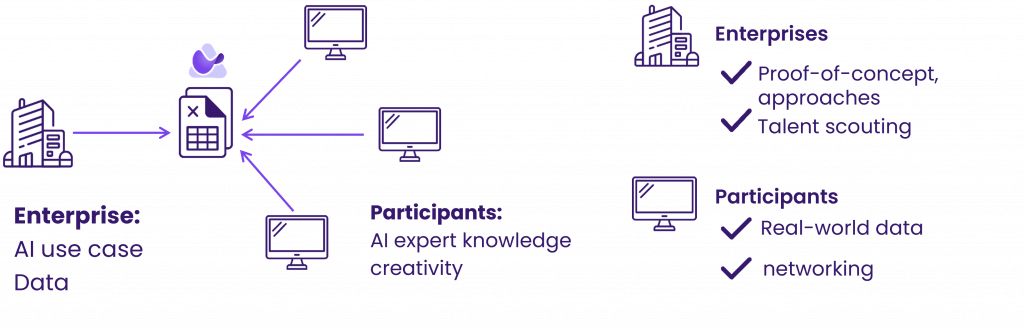
The Industry Challenge is a collaborative offer by hessian.AI that brings together companies and AI experts to jointly develop solutions for specific AI use cases. This results in well-founded approaches to real-world applications and provides a basis for further development and integration into the company’s context.
What the enterprises bring to the table
- Initial use case idea and objectives
- Domain knowledge and problem understanding
- Relevant data and application context
What hessian.AI brings to the table
- Methodological and technical AI expertise
- Data assessment and challenge design
- Challenge organization and execution
- Access to talent and research environment
- Evaluation of results from an AI perspective
The format is tailored to the specific needs of each company and can be implemented, for example, as a hackathon, a hybrid challenge, or a workshop series.
More on Hackathons?
In an interview with Bartosz Kajdas from STARTUPS FROM SCIENCE, Dr. Severine Rupp, Cooperation Manager at hessian.AI, explains how motivated young talents are tackling real-world Industry Challenges. Through hands-on projects, they gain valuable experience while developing innovative solutions to concrete challenges faced by industry.
The initiative is further supported by the EU project Jupiter AI Factory (JAIF), , which contributes to training and talent development and helps create new opportunities for the next generation of AI talent.
Prior Industry Challenges
Industry Challenge with WASTEER
AI Serving Waste-to-Energy Operations
Optimising Waste Bunker Management for Efficient Energy Production


Ready to make waste-to-energy operations smarter, more data-driven, and greener?
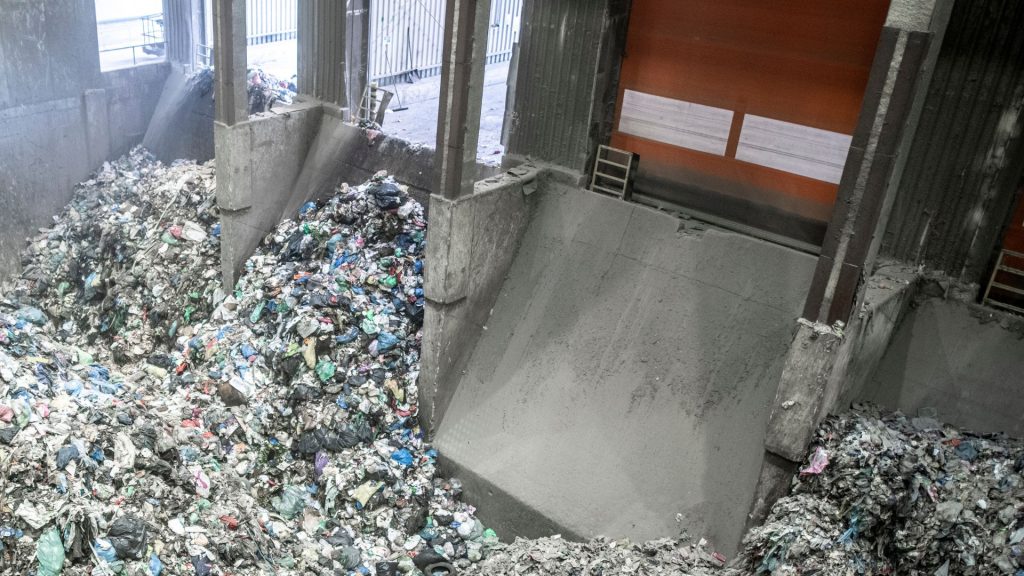
Efficient waste incineration is a key component of modern waste-to-energy infrastructure. In 2026, it goes far beyond simply burning waste, requiring careful control of input materials and process stability to maximise energy recovery and meet environmental regulations.
To explore this challenge, the industry partner Wasteer, together with hessian.AI and the Developer Student Club Darmstadt, organised a 24+ hour hackathon featuring real-world problem statements from industrial operations.
During the event, participating teams worked with authentic industrial datasets to optimise the storage, mixing, and preparation of waste for incineration. The focus was on intelligent waste bunker management as a critical lever for ensuring stable plant operation, maximising energy yield, and maintaining compliance with regulatory constraints.
A practical example of how AI-driven methods can deliver tangible value in complex industrial waste-to-energy operations.
Impressions of the Event

Industry Challenge with TransnetBW
AI Serving Grid Stability
Anomaly Detection in the European Transmission Grid for Electricity


Reliable access to electricity at all times forms the backbone of our regional, national, and European infrastructure. To ensure this stability, control centers operated by grid operators continuously monitor the energy system.
The industry challenge “AI Serving Grid Stability”, organized by hessian.AI, TransnetBW, Fraunhofer IEE, and the House of Energy, demonstrated how AI can support this process. The participating teams developed models capable of detecting anomalies at an earlier stage, potentially reducing the need for costly countermeasures.
A compelling example of how AI can create real value in the energy sector.
The Case
The Case
Europeans are used to constant electricity supply and rarely experience blackouts. TransnetBW’s control room is one of the places where people are working 24/7 to maintain this seemingly inexhaustible flow. The company is one of four transmission system operators in Germany and industry partner of our Challenge 2023. Transmission system operators ensure that the electricity grid is stable. To do this, the same amount of electricity must be fed into the grid as is taken out at any point in time to maintain a frequency of 50 Hertz. To ensure this, TransnetBW uses automated control signals to instruct power plant operators to ramp up or down their infeed. In this challenge we look at the secondary reserve (a primary and a tertiary version also exists) that must be active after a maximum of 5 minutes.
Until recently, every European state used power plants in their own country to maintain the system balance. This has regularly led to the following situations: In Germany, for example, a power plant is ramped up and a few kilometers further across the border another power plant is ramped down. The costs that are incurred by this inefficient use of reserves are ultimately paid by all electricity customers. Since 2022, TransnetBW operates the PICASSO platform that coordinates the deployment of secondary reserve in real time, ensuring an optimal usage of reserves in a European domestic balancing market. This leads to macroeconomic savings of several hundred million euros per year and contributes to the decarbonization of the balancing market
The Challenge
The
Challenge
From its control room, TransnetBW operates the PICASSO platform and thus the world’s largest system for real time optimization of electricity flows. To ensure the correct functionality of the platform, information on imbalances, reserves, transmission capacities and many other time series are constantly monitored. These monitored features sometimes behave strangely, indicating to the control room engineers that it might be necessary to take action. Algorithms that recognize anomalies early and precisely may be of great help here. That’s why TransnetBW, in cooperation with Fraunhofer IEE, provides a previously unpublished data set consisting of various PICASSO platform time series to participants. An (AI) algorithm should be tuned to detect anomalies in platform operation. If this is successful, AI based solutions could support TransnetBW and other transmission system operators in better recognizing deviations from regular operation and in acting accordingly. The challenge aims at evaluating different solution methodologies in a short period of time and establishing personal contacts between industry and AI developers.
The Format
The Format
You could participate as an individual or as part of a team. Teams could be formed during the kickoff event, but team changes or new team formations were possible during the entire challenge duration.
The data set was available via the Kaggle platform. You could use your unrestricted toolbox of techniques and modules to solve the challenge. You could resubmit your result anytime until the deadline.
For discussions and requests, prior, during and after the challenge, we opened up a dedicated Discord server to check on the participants.
This challenge was not simply about working your magic with data, but also about fostering an exchange between the participants. This is why we planned events as well as working periods.