
Manual with building instructions for AI-enabled drones published
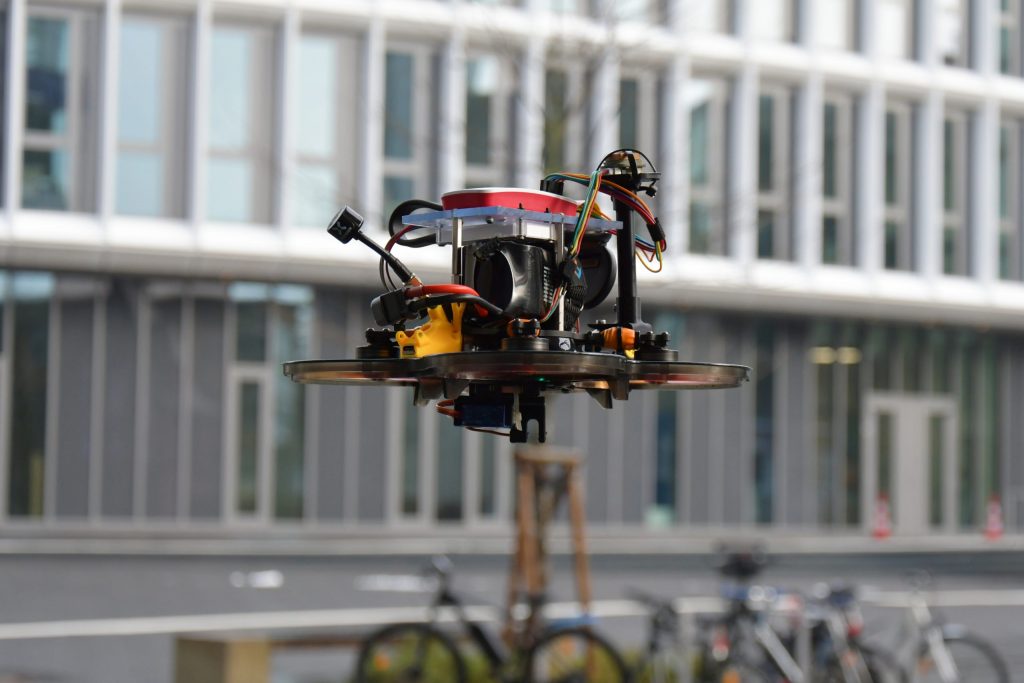
Since the summer semester of 2025, a project team at Frankfurt University of Applied Sciences has been exploring and teaching how artificial intelligence can enhance drone technology. Their work has resulted in a bilingual handbook that provides technical foundations and building instructions for AI-powered drones. The handbook incorporates findings from the research project “AI-supported drone platform,” which was funded by hessian.AI from the Connectom Networking and Innovation Fund, as well as from accompanying student theses and experiences from the master’s course “AI Drones” at Frankfurt UAS.
Since the summer semester of 2025, a project team from the Computer Science Department at Frankfurt University of Applied Sciences (Frankfurt UAS) has been conducting numerous research activities and teaching courses on the topic of drones with artificial intelligence (AI).
As a result of this work, a bilingual handbook with technical basics and building instructions for AI-enabled drones is now available. It is designed for various scenarios in research and teaching in German and English and is being continuously developed.
The goal is to create a vibrant community
It was published under a free license. “Our goal is to create a vibrant community that not only uses these instructions for teaching and research projects, but also develops them further,” says Prof. Dr. Christian Baun, program director of the Master’s program in General Computer Science. “Comments and suggestions for improvement are expressly welcome.”
Components for a tight budget
The handbook offers an introduction to the complex topic of drones with AI. It focuses on the development (including the selection of suitable hardware and software components), construction, and operation of drones in teaching and research projects.
When selecting the components, particular attention was paid to adaptability to different application scenarios, acquisition costs, robustness, long-term market availability, and the quality of documentation and manufacturer support.
Focus on practical applications
A comprehensive treatise on drones and AI is expressly not the aim of the document. “The focus is on the technologies and solutions that were current at the time of writing and with which practical experience has been gained in the field of computer science at Frankfurt UAS,” explains Baun.
The handbook incorporates findings from the research project “AI-supported drone platform,” which was funded by hessian.AI from the Connectom Networking and Innovation Fund, as well as from accompanying student theses and experiences from the master’s course “AI Drones” at Frankfurt UAS.
The focus is on the independent development of AI-supported drone systems by small groups. Each semester, students develop, design, and program innovative systems. Tasks include hardware integration, connecting sensors and AI accelerators, designing, implementing, and testing specific application scenarios such as object and animal recognition, environmental monitoring, inspection and logistics tasks, autonomous navigation, and drop mechanisms.
The Department of Computer Science at Frankfurt University of Applied Sciences presents bilingual guidelines on community use for research and teaching – comments and suggestions for improvement are expressly welcome.
The manual is available at the following link: https://github.com/christianbaun/aidrones
Frankfurt University of Applied Sciences, Faculty 2
Computer Science and Engineering, Prof. Dr. Christian Baun
E-Mail:
Press release by Claudia Staat, Communications at Frankfurt UAS.
Photo Copyright: Benedikt/Frankfurt UAS