
AI is changing everything – people, machines, ethics
At the event “AI changes everything – humans, machines, ethics” held by the Protestant Academy in Frankfurt, experts from the fields of research, ethics, and business discussed how responsible AI can be designed.
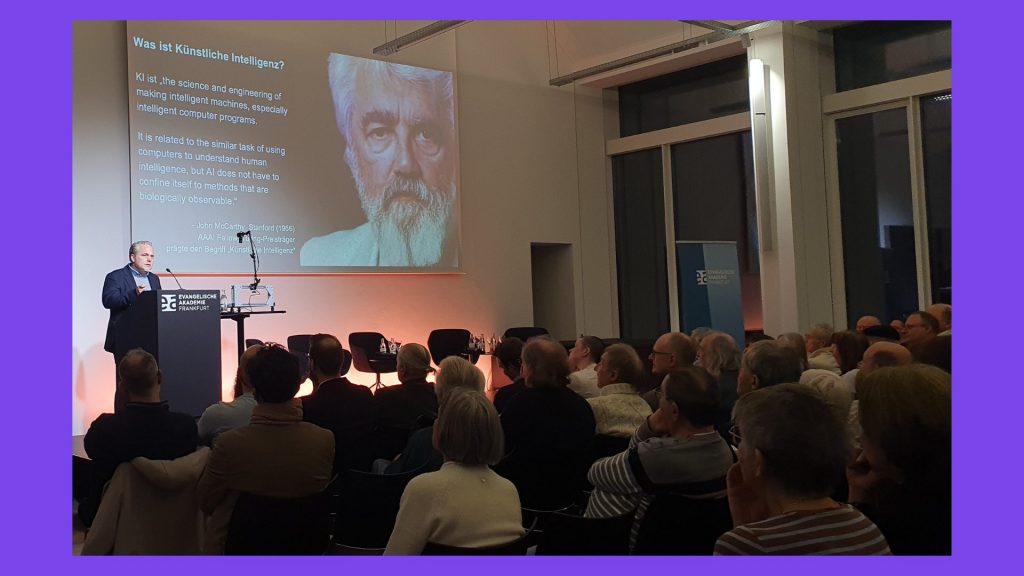
Prof. Dr. Kristian Kersting, co-director of hessian. AI and professor of machine learning at TU Darmstadt, with a wide-ranging presentation: from the fundamental question of what artificial intelligence actually is, to its significance for human thinking and social developments, to the question of which ethical principles and technological paradigms should guide its future.
This was followed by a panel discussion with Prof. Dr. Kevin Bauer (Goethe University Frankfurt) and Prof. Dr. Toni Loh (Bonn-Rhein-Sieg University of Applied Sciences) and a live demonstration by Sören Heß, founder of the Darmstadt-based startup PanocularAI. The event was moderated by Dr. Helge Bezold (Evangelische Akademie Frankfurt).
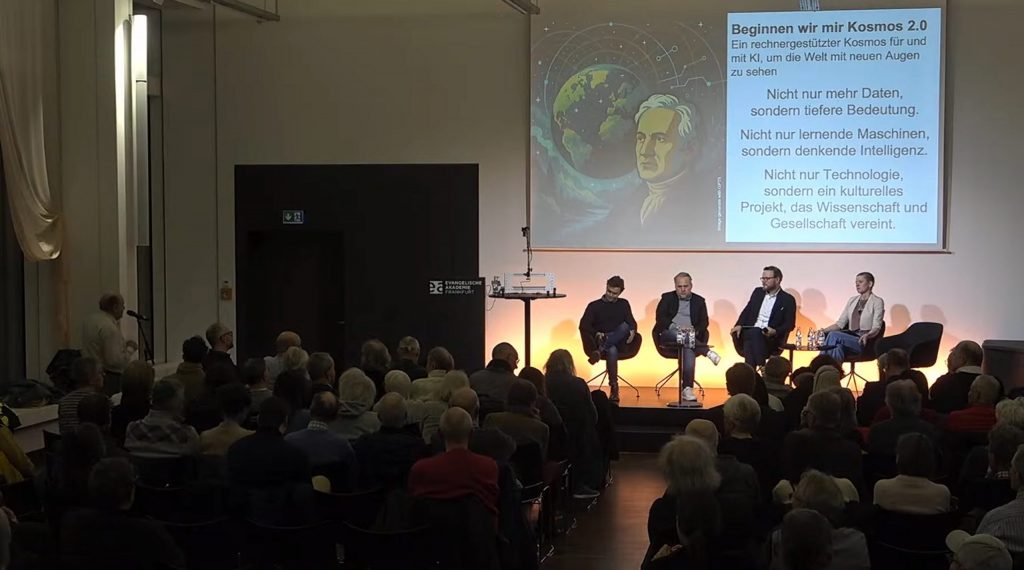
From left: Prof Kevin Bauer, Prof Kristian Kersting, Dr Helge Bezold, Prof Toni Loh
Evangelische Akademie Frankfurt (Screenshot of Livestream)
AI as a cultural asset and thinking tool
For Kristian Kersting, artificial intelligence should be “a cultural asset that everyone has access to.” Modern AI systems open up new perspectives on what still distinguishes artificial intelligence from human creativity today. As an example, Kersting cited an experiment in which AI composed music in the style of Richard Wagner. The result was pleasant, but did not match the genius of the master. Nevertheless, such experiments put creativity as a unique human characteristic to the test – and demystify our ideas of what it means to be creative.
Addressing the question “What is AI?”, Kersting emphasized: “It’s not about thinking less for yourself – it’s about having support in your thinking.” Used correctly, AI can make a significant contribution to overcoming social challenges such as climate change, skills shortages, and fragile supply chains. “AI is here to stay,” he concluded.
New paradigms instead of “bigger and bigger”
From a technological perspective, Kersting is critical of the one-sided fixation on scaling large models. The so-called “hyperscale hypothesis” – bigger is better – falls short. Data volumes are not growing at the same rate as the demands of the models, while energy consumption and the concentration of computing power are increasing.
At the RAI – Reasonable Artificial Intelligence cluster of excellence based at TU Darmstadt, Kersting is working with a team of AI researchers on alternatives: “We want to combine deep learning, symbolic thinking, software engineering, and human diversity.” The goal: AI that can be assembled from different building blocks – “a bit like playing with Lego.” In the long term, this could mean rethinking computer science and no longer viewing code as “dumb” but as intelligent.
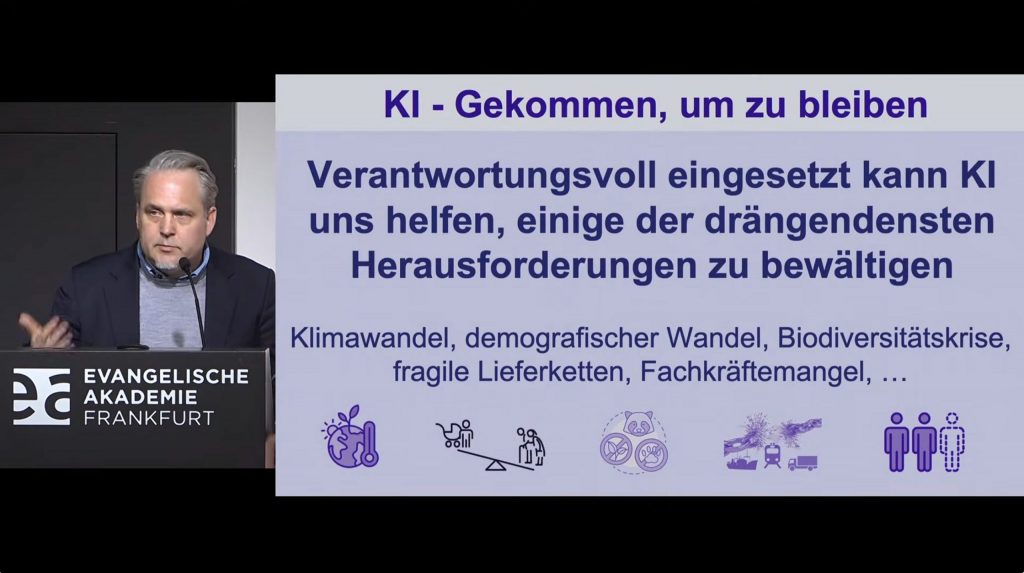
Prof Kristian Kersting
Evangelische Akademie Frankfurt (Screenshot of Livestream)
For a constitution for AI
The ethical framework was also a particular concern for Kersting. “AI systems need a constitution,” he said. It is utopian to believe that you can simply collect all the data and the right thing will automatically emerge in the end. “We humans set rules for ourselves – we must do the same for AI systems.” Only in this way can distortions and unintended consequences be avoided.
Kersting also called for the strengthening of public research institutions. They are predestined to consider ethical issues from the outset and to incorporate them into the development of new technologies. Responsibility for ethical rules should not be left to companies whose actions are more strongly influenced by economic interests.
Discussion on ethics and responsibility
In the subsequent discussion with Prof. Dr. Kevin Bauer (Goethe University Frankfurt) and Prof. Dr. Toni Loh (Bonn-Rhein-Sieg University of Applied Sciences), it became clear how important interdisciplinary thinking is for the future of AI. Loh emphasized that ethics is now being incorporated more strongly into technical developments—an important step forward. Kersting stressed that the question of how ethical principles can be reflected in machines remains open: “You can’t allow an intelligent system without restrictions.” We have to show politicians that it’s not too late – we have something to contribute.”
Bauer emphasized that Germany already has excellent initiatives that should be more closely networked and thought out beyond pure regulation. “We need spaces that have an interdisciplinary effect – this is a value that we often underestimate.”
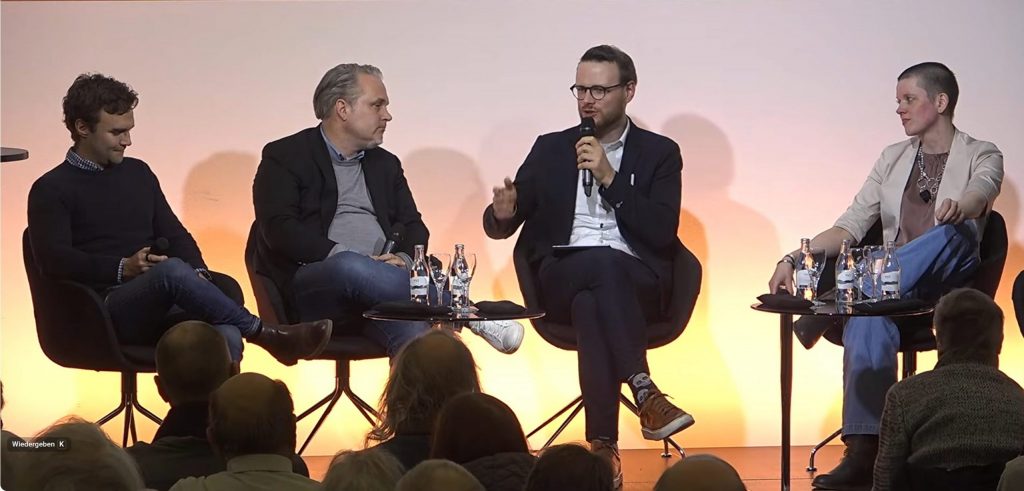
From left: Prof Kevin Bauer, Prof Kristian Kersting, Dr Helge Bezold, Prof Toni Loh
Evangelische Akademie Frankfurt (Screenshot of Livestream)
European innovation made visible
Sören Heß, founder of the TU spin-off startup PanocularAI, provided practical proof that innovation and value orientation can go hand in hand. With a specially developed network architecture, the company brings AI directly to end devices – efficiently, data-sparingly, and confidently. In a live demonstration, Heß showed how the system links text and image comprehension. This is an example of a technological development that makes European AI expertise tangible – from Hesse.
Watch Impuls and Talk on YouTube
Evangelische Akademie Frankfurt
The series continues: Next event on February 16, 2026
On February 16, the Evangelische Akademie Frankfurt will address the question of how new technologies are changing the world of work – and what this means for people, companies, and society: AI and the future of the world of work.