
Building mathematical bridges to computer science
Fourth Alexander von Humboldt Professorship for TUDa – Award winner Dr Michał Pilipczuk
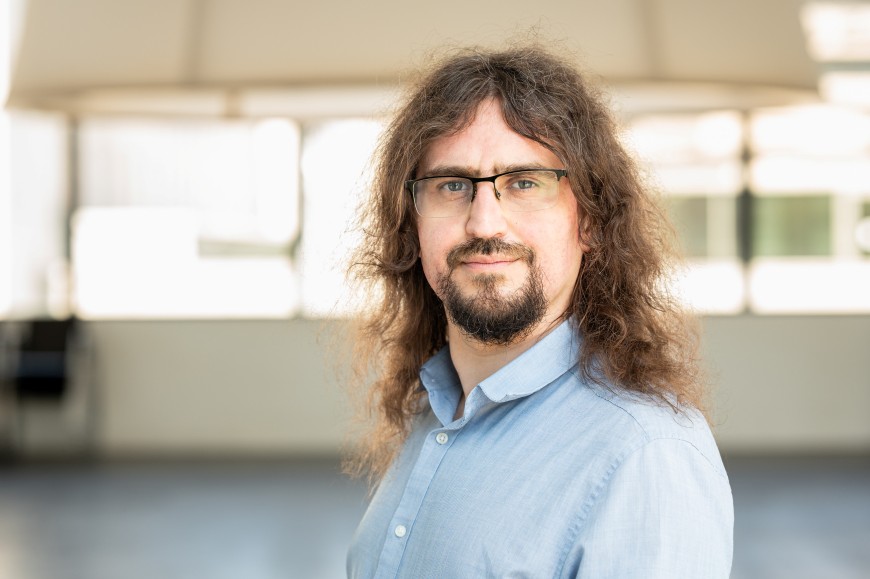
One of the eight Alexander von Humboldt Professorships has been awarded to TU Darmstadt: Dr. habil. Michał Pilipczuk, a mathematician and computer scientist nominated by the university, has been selected for Germany’s most prestigious international research award. The Cluster of Excellence Reasonable Artificial Intelligence (RAI) will also benefit in particular from his research at the interface between discrete mathematics and theoretical computer science.
“Michał Pilipczuk is an internationally recognised leading researcher whose pioneering work at the interface of mathematics and computer science aligns exceptionally well with our vision at TU Darmstadt and within the Alliance of the Rhine-Main-Universities (RMU),” says TU-President Tanja Brühl. “Through his influential contributions and extensive network, he will have a lasting impact on research in our Research Field I+I and further deepen collaboration across the RMU. We look forward to working with an inspiring and highly innovative colleague.”
In Dr Michał Pilipczuk, TU Darmstadt has succeeded in recruiting one of the world’s leading researchers in the fields of algorithm design, logical methods in computer science and structural graph theory. The appointment of Pilipczuk brings the already closely interlinked departments of Computer Science and Mathematics at TU Darmstadt even closer together.
Combining modern AI approaches with rigorous automated logic
Unlike other German universities, a large proportion of theoretical computer science research at TU Darmstadt is already based within the Department of Mathematics. TU Darmstadt is a pioneer in research at the interface between both disciplines – a field that will play a central role in the future due to the triumph of Artificial Intelligence (AI). The aim is to position both fields so that they are equipped to meet the challenges and opportunities of the AI revolution by combining modern AI approaches with rigorous automated logic. This is of crucial importance for the next generation of trustworthy AI.
In particular, algorithmic methods with formal guarantees – one of the new Humboldt Professor’s core areas of expertise – will be crucial for linking future computing systems with formal reasoning tools, thereby ensuring alignment with human values and social norms; in other words, for developing systems that are efficient, transparent, explainable and traceable. Pilipczuk’s expertise will thus also benefit the Cluster of Excellence Reasonable Artificial Intelligence (RAI), which is dedicated to developing a new generation of AI systems based on sensible resource utilisation, data protection and continuous improvement. Pilipczuk will also strengthen the Information and Intelligence (I+I) research field.
Plans for a center for the mathematical foundations of computer science
Looking ahead, a center for research in mathematical foundations of computer science is to be established within the framework of the Rhine-Main Universities (RMU), which will position TU Darmstadt, together with Goethe University Frankfurt and Johannes Gutenberg University Mainz, as one of the leading institutions at the interface between discrete mathematics and computer science. This objective is also linked to the joint application by the RMU partners for the status of a Network of Excellence. In this context, Pilipczuk will be an outstanding academic figure and a central component of the future center.
Pilipczuk’s appointment is closely linked to the RMU’s strategic goals within the framework of the EXCITE application for excellence and opens up new opportunities for complementary collaboration between the RMU’s sites and disciplines. Ten RMU research groups are already conducting joint research and teaching at the interface between mathematics and computer science. His appointment substantially strengthens this development and specifically expands the research field of discrete mathematics as part of the “Area of Potential: Modelling Science”. At the same time, the appointment supports EXCITE’s long-term goal of establishing twelve strategic top-level appointments at the level of Alexander von Humboldt Professorships within the RMU.
About the person
Michał Pilipczuk completed his Master’s degree in Computer Science in 2011 and his Master’s degree in Mathematics in 2013 at the University of Warsaw. In 2013, he was awarded his PhD in Computer Science at the University of Bergen. After completing his PhD, Pilipczuk returned to the Faculty of Mathematics, Computer Science and Mechanics at the University of Warsaw in 2014. In 2015, he was appointed Assistant Professor at the age of 27. In 2020, he received an ERC Starting Grant for his project “BOBR – Decomposition Methods for Discrete Problems”. In 2021, he completed his habilitation and became an Associate Professor in 2022. In 2025, he was awarded an ERC Consolidator Grant for “Towards a unified structure theory for dense graphs (WYDRA)”.
Pilipczuk has received numerous awards. These include the prestigious Cor Baayen Award for outstanding early-career researchers in computer science and applied mathematics, and the Witold Lipski Award for young Polish computer scientists.
Alexander von Humboldt Professorship
The Alexander von Humboldt Professorship is Germany’s most highly endowed scientific award and is conferred exclusively on top researchers who are world leaders in their field and active abroad. The Humboldt Professorship is funded by the Federal Ministry of Research, Technology and Space (BMFTR). It enables long-term, forward-looking research to be carried out at universities and research institutions in Germany and makes a lasting contribution to the international competitiveness of Germany as a research location. Since 2008, up to ten Humboldt Professorships have been awarded each year. Since 2026, the BMFTR’s ‘1000-Köpfe-Plus’ programme has made it possible to award Humboldt Professorships with funding of up to ten million euros.
Learn more
Bettina Bastian / TU Darmstadt